Some weekends, you just want to build something uselessly beautiful.
For me, that meant writing a lightweight retry proxy — a small layer that would sit between my service and a flaky third-party API.
Nothing enterprise-grade. No Kafka, no frameworks, no resilience libraries.
Just Java, a terminal, and curiosity.
It wasn't meant to be useful.
It was meant to remind me what useful code feels like.
🔗When All You Want Is "Try Again Later"
The idea was simple:
- Forward API requests downstream.
- If they fail, queue them for retry.
- Process retries in the background until success or timeout.
A tiny open-source-style playground — the kind you'd hack together between cups of coffee.
🔗The Old Reflex: "I'll Build My Own Linked List"
My muscle memory kicked in:
class RetryNode {
    Request request;
    RetryNode next;
}
I could've chained these up, managed head/tail pointers, and built my own in-memory queue.
But halfway through sketching it out, I stopped.
I wasn't trying to prove I could build data structures.
I wanted to prove I could still use the language well.
Java already gives us decades of concurrency-safe, memory-efficient primitives.
I didn't need to out-engineer them — I just needed to rediscover them.
So I reached for an old friend I'd long ignored:
Deque<Request> retryQueue = new ArrayDeque<>();
🔗Designing the Retry Queue (and Why It Works)
Once the core idea took shape, I stepped back to sketch how requests would actually move through the system.
That's when this simple sequence diagram brought everything together:
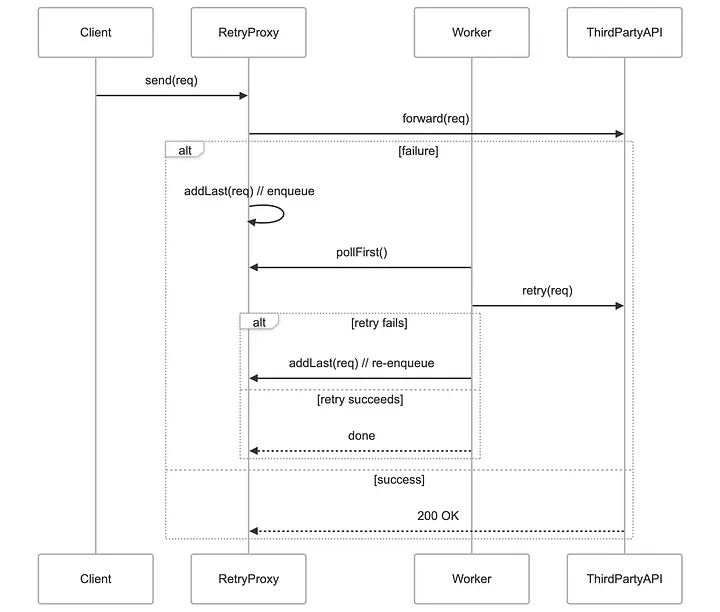
At a glance, it shows exactly what matters:
Clear boundaries — each participant has one role:
- Client → sends requests.
- RetryProxy → forwards and decides when to retry.
- Worker → executes retries in the background.
- ThirdPartyAPI → the sometimes unreliable downstream dependency.
Intent made visible — every arrow is readable:
- A failure calls
addLast(req)— the most natural way to say "try again later." - A worker thread polls with
pollFirst()— meaning "oldest first." - Successful requests complete quietly, just like they should.
Graceful failure flow — the alt branches tell the real story of resilience:
[failure]→ enqueue[retry fails]→ re-enqueue[retry succeeds]→ done
No frameworks, no annotations — just clean, visible behavior.
🔗The Java Shape Behind the Diagram
Here's how that design translated directly into code:
class RetryProxy {
    private final Deque<Request> retryQueue = new ArrayDeque<>();
    private final ScheduledExecutorService scheduler =
        Executors.newScheduledThreadPool(2);

    void send(Request req) {
        try {
            forward(req);
        } catch (IOException e) {
            System.out.println("Failed: " + req.id + " → queued for retry");
            retryQueue.addLast(req); // enqueue on failure
        }
    }

    void start() {
        scheduler.scheduleAtFixedRate(this::processQueue, 0, 2, TimeUnit.SECONDS);
    }

    private void processQueue() {
        Request req = retryQueue.pollFirst();
        if (req == null) return;

        try {
            forward(req);
        } catch (IOException e) {
            req.incrementRetries();
            if (req.shouldRetry()) retryQueue.addLast(req); // re-enqueue
        }
    }

    private void forward(Request req) throws IOException {
        // Simulate network call to ThirdPartyAPI
    }
}
🔗Seeing Behavior, Not Just Code
Watching that retry loop come alive felt like watching a small ecosystem breathe:
- a request fails,
- the proxy quietly queues it,
- the worker gives it another shot,
- and eventually, everything stabilizes.
It's not complex, but it's alive — and you can reason about every transition. That's the difference between code that "runs" and code that tells a story.
🔗The Temptation to Overbuild
There's something seductive about low-level control. Every seasoned engineer has that voice in their head whispering:
You can make this faster… tighter… smarter.
But I've learned that every time I rewrite something the JDK already does, I'm not expressing mastery — I'm expressing distrust.
Java's ArrayDeque already solves this problem elegantly:
- It's lock-free,
- cache-friendly,
- and amortized constant time for add/remove operations.
It's been optimized by people who think about micro-architectural memory access patterns for fun.
All I had to do was use it with intention.
This project wasn't about proving depth — it was about practicing restraint.
Re-implementing a queue in 2025 doesn't make you clever; using Deque well does.
Java's standard library already encapsulates the right trade-offs:
- backed by a resizable array rather than pointers,
- no synchronization overhead like
StackorVector
When the language offers something beautifully simple, sometimes the smartest thing you can do is just say thank you and use it.
🔗Inside Java's Deque: What Makes It Elegant
The more I used Deque, the more I appreciated how well it captures what good APIs should be — simple at the surface, powerful in composition.
At its core, Deque (Double-Ended Queue) is exactly what it sounds like:
a linear collection supporting insertion and removal at both ends.
That one design choice unlocks a world of patterns.
What I love is how expressive the method names are.
They don't hide complexity behind abstractions — they describe behavior.
You can almost read your concurrency logic aloud and know what's happening.
retryQueue.addLast(req);        // enqueue at end
retryQueue.removeFirst();       // oldest first
retryQueue.addFirst(urgentReq); // bump priority
🔗Deque Implementations: Choosing the Right One
Not all Deques are created equal — and understanding their trade-offs is what separates a clean solution from a latent performance bug.
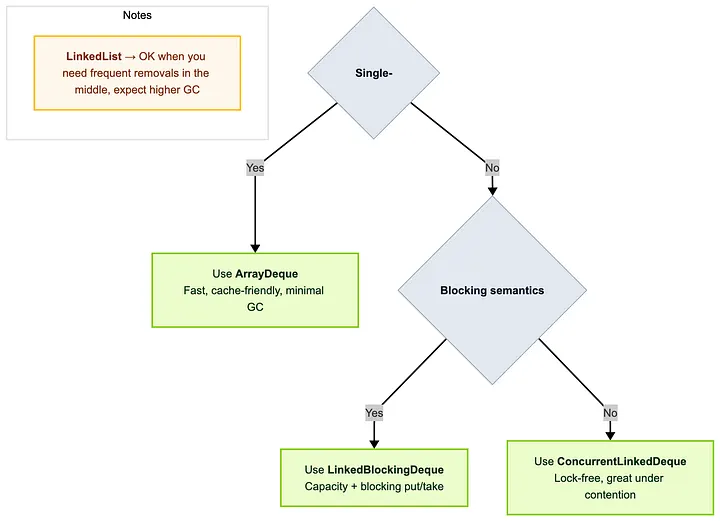
The decision tree above captures the key questions:
Is it single-threaded?
- Yes → Use
ArrayDeque— Fast, cache-friendly, minimal GC pressure
No — Do you need blocking semantics?
- Yes → Use
LinkedBlockingDeque— Capacity + blocking put/take - No → Use
ConcurrentLinkedDeque— Lock-free, great under contention
🔗Practical Use Cases of Deque
Once you start noticing it, Deque is everywhere. It's one of those invisible workhorses that quietly keeps modern Java frameworks humming — from messaging systems to caches to Spring internals.
It's not the hero of the architecture, but it's part of the infrastructure of elegance.
🔗Retry Buffers and Back Pressure Loops
Your classic use case — queue up failed requests, re-enqueue on failure, process oldest first — is the same principle that powers many internal request pipelines.
🔗Apache Kafka
Kafka's network client layer maintains a Deque per connection to track outstanding requests:
InFlightRequestsuses aMap<NodeId, Deque<NetworkClient.InFlightRequest>>to represent pending network operations for each broker connection.
🔗Annotation Traversal in Spring Framework
Spring itself leans on Deque in multiple modules — not publicly exposed, but deeply embedded in core utilities.
Annotation scanning:
AnnotationTypeMappingsusesArrayDequeandDequefor managing annotation traversal order during metadata resolution.
🔗Why It Matters — Even When AI Can Write the Code
We've reached a point where AI coding tools don't just autocomplete lines — they generate entire working implementations.
Ask Claude, Cursor, or Copilot to "build a retry mechanism," and you'll get a runnable solution in seconds.
But the real question isn't can it build it — it's will it build it right?
Because here's the truth: if you don't know what a Deque is, and if you don't understand why it's better for ordered, reversible, or bounded workflows — then you can't tell the AI to use it.
You'll get a perfectly valid queue, or maybe a synchronized List, and it'll even pass tests. But it won't reflect intent. It won't express the system's rhythm — that subtle, almost architectural decision between order and flow.
AI can write a retry queue.
Only you can shape it into a resilient one.
That's why fundamentals still matter.
Not because we need to hand-craft everything — but because we need the language to direct these tools.
When I asked an AI assistant to generate a retry layer, it produced a BlockingQueue loop — correct, functional, but not expressive.
When I said "use a Deque for retry ordering and prioritization", the design immediately improved.
That difference — between asking for code and asking for the right code — comes only from understanding.